



Last Thursday, I wrote a simple LinkedIn post about Tilly Norwood, the synthetic actress, and the controversy surrounding “her.” I closed with an equally simple question: Who will lose their job to AI first—Margot Robbie or a rank-and-file credit union employee?
Despite what I thought I knew about LinkedIn’s algorithm at the time, the post was a viral success at least by LinkedIn standards, generating some 4,040 impressions as of the Sunday morning brain dump of which you are now seeing the fruit. I wish I could say I planned this all out, but the success of this post came as quite a pleasant surprise. Researching the “why” of this success over the last couple of days taught me plenty about LinkedIn and how to replicate that success.
I won’t bore you with the details, but I will tell you that pondering Tilly brought me to an epiphany about the AI debate itself. We are all focused on the immediate, visible threat of AI—the Tilly Norwood scenario—but the real, systemic danger lies beneath the surface, in what one tech blogger named Cory Doctorow calls the “subprime intelligence” bubble.
The Tilly Factor: A Masterful Sales Pitch
The Tilly Norwood story is the ultimate example of the AI salesman’s pitch.
The synthetic actress is a symbol of a highly visible, yet still fundamentally limited, technology being sold as a replacement for high-value human labor. My LinkedIn post tapped into this fear: Is the highly replaceable (even by another human) credit union employee more at risk than an “irreplaceable” creative?
This type of question works because it forces us to confront the visible reality of automation. It is the story being told to boards and investors: AI can do the job, so “repurpose” the worker.
My post’s success, in a way, validated the AI bubble’s primary engine: You can achieve massive visibility and engagement (impressions) if you have a great hook (Tilly) and a simple, polarizing narrative.
But what if the product being sold—the AI itself—is financially unsound?
The Invisible Threat: The Subprime Intelligence Bubble
The article I read by Doctorow on the “econopocalypse” and “subprime intelligence” presents a terrifying counterpoint. He argues that the real danger isn’t AI taking our jobs, but the unsustainable financial mania driving the AI industry.
Doctorow’s thesis is stark: The AI boom is a massive economic bubble driven by monopolistic companies that have run out of organic growth. They are pushing AI as their next great revenue source, but the underlying unit economics of these large models are, as tech podcaster Ed Zitron put it, “dogshit.”
The Financial Lie: AI models are becoming exponentially more expensive with each generation, and the money flow relies on absurd accounting practices—like investment firms buying chips from the same companies they are loaning money to.
The Failed Product: The phrase “subprime intelligence” is apt. Just as subprime mortgages were sold as sound investments when they were fundamentally defective, the AI being sold today is often defective, unscalable, and deeply unprofitable.
The Catastrophe: Doctorow warns that these companies are convincing bosses to “repurpose” human workers and replace them with this financially toxic, flawed AI. When the inevitable bubble bursts, these money-incinerating models will be shut off, the workers will be permanently gone, and the entire economy will be left in “ashes and rubble.”
The Balancing Point: We Are Debating the Wrong Question
Tilly Norwood and the “econopocalypse” are two sides of the same counterfeit coin.
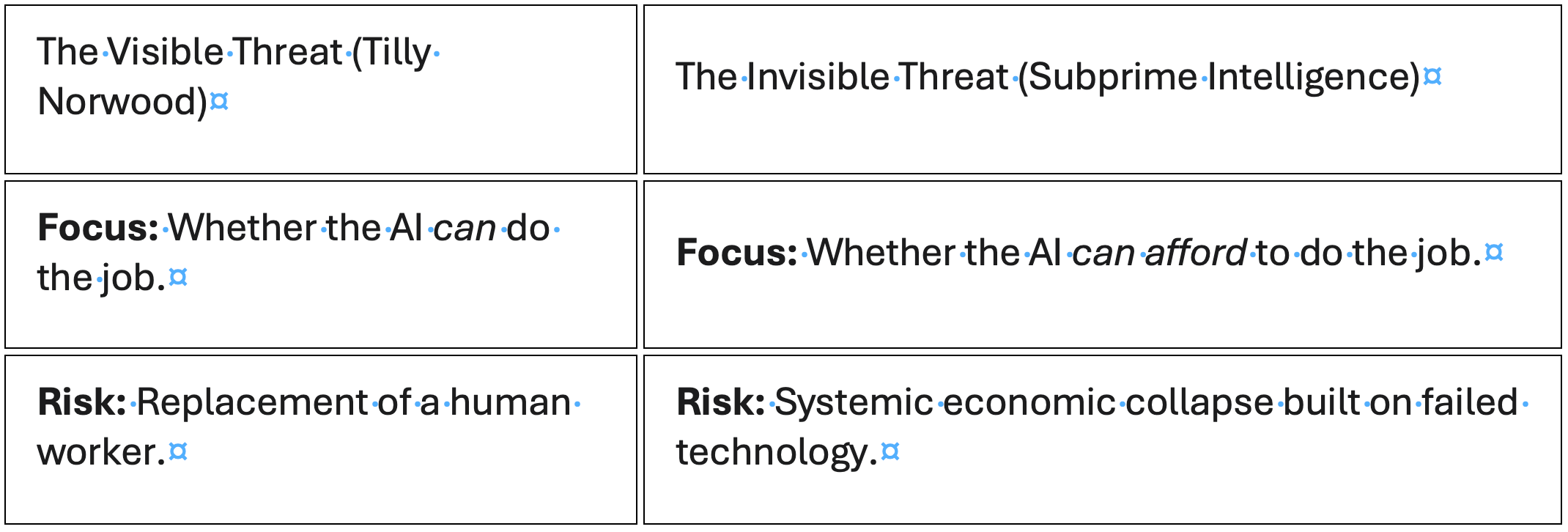
The true lesson here is that our collective focus on Tilly Norwood—the visible automation risk—is a distraction. The question isn’t whether AI can replace the credit union worker or the actor; the question is whether the venture-capital money is going to disappear before that even becomes an issue.
The AI bubble doesn’t need superintelligence to cause a crisis; it just needs enough subprime intelligence to convince bosses to make irreversible decisions before the capital runs dry.
What I Know: The most important AI conversation we can have on LinkedIn right now isn’t about the capability of AI, but the stability of the companies selling it. According to Doctorow, “a third of the stock market is tied up in seven AI companies that have no way to become profitable.” We need to stop debating A vs. B scenarios and start questioning the financial foundation of the entire AI growth story.
If the foundation models are set up to fail, the result will be a far greater professional crisis than simple job replacement—it will be an economy hollowed out by a speculative delusion. We need to puncture this bubble before the economic debt becomes insurmountable.