


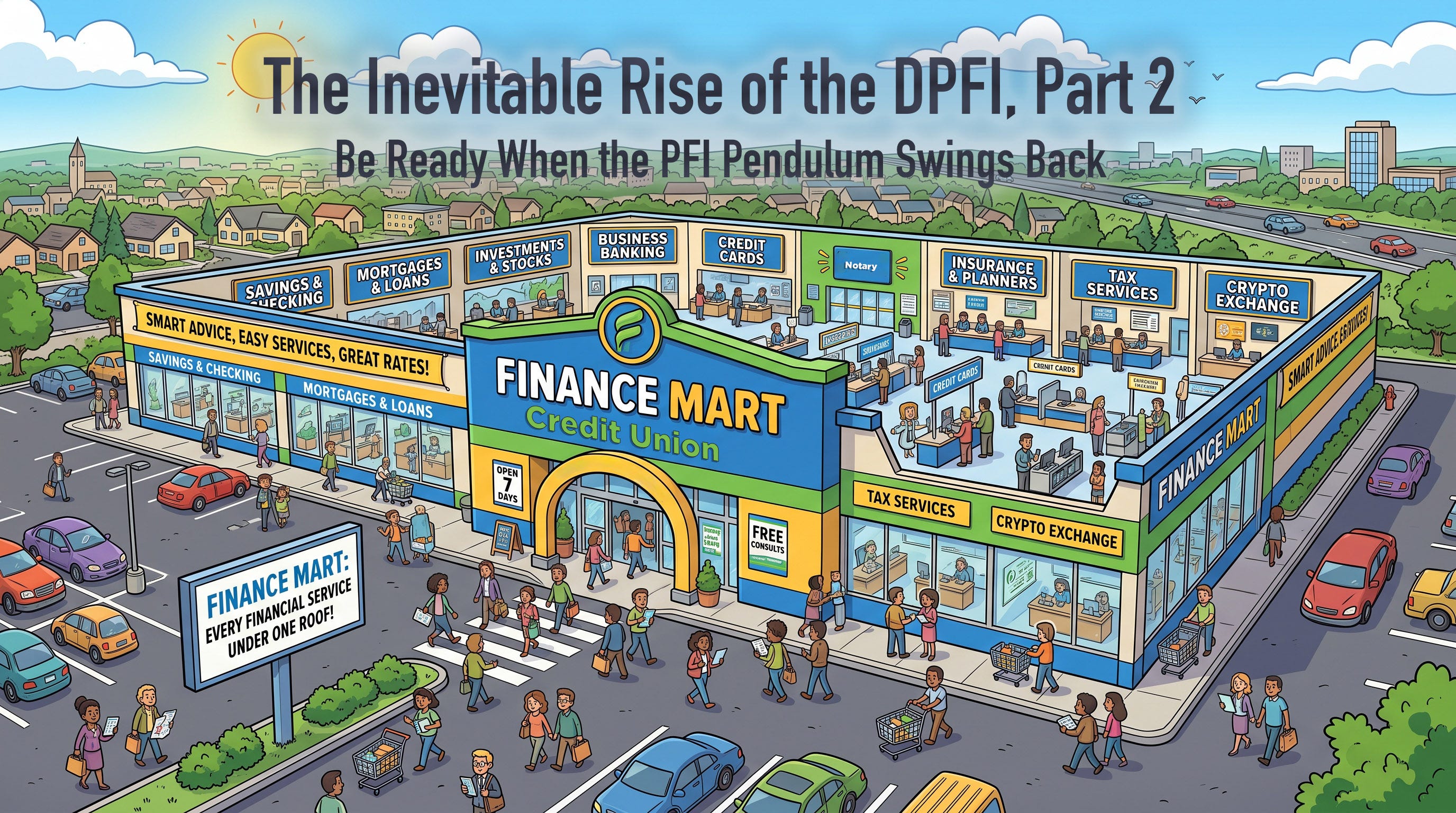
In Part 1, we tackled the financial app frenzy on our smartphones, called out the lazy industry dogma that the primary financial institution is dead, and examined how credit unions got trapped in “skeuomorphic thinking” – trying to digitize a brick-and-mortar branch lobby. Now it’s time to talk about the cure.
What Not to Do
I hope my premise is clear by now. Becoming your members’ digital primary financial institution is within reach of any credit union. The tools are there. The first thing that needs to change is the thinking. With that in mind, it makes sense to look at what hasn’t worked well along this seemingly rough and rocky road. Specifically, let’s talk about data aggregation.
It seems like a quick and easy fix. Provide your members with a more or less complete picture of their finances. But there’s a reason Yodlee, Mint and your credit union’s PFM never captured the imaginations of the public in a big way.
The root problem is, you can’t transact with a picture. It’s important to know when there’s a crisis situation in one of your accounts. It’s more important to be able to do something about it.
Bottom line: People want to do, not view.
What We Can Learn from Walmart
Full disclaimer: I’m not a big fan of Walmart. Hundreds of shopping carts jockeying for position inevitably leads to a San Filippo anxiety attack of one degree or another. I feel the same way about Costco. And Albertsons during peak grocery hours.
However, Walmart did get something right. The popular thinking is that trying to be all things to all people in this digital age is futile. In the context of banking, it’s an easy way to explain away the death of the PFI. Walmart respectfully disagrees.
When they started building Walmart Supercenters, they set out very intentionally to be all things to all people. Shoppers don’t go to a Walmart Supercenter because they can get a loaf of bread or a quart of motor oil or Duck Dynasty slippers or a flat-screen TV. They go there because they can get all of these under one roof, in some cases 24 hours a day. They’ve taken the guesswork out of “I need X. Where should I go to buy that?” because no matter what X is, the answer is the Walmart Supercenter. They’ve become the PSO – primary shopping outlet.
Now think of your credit union as a financial supercenter. Whether the member wants to buy and custody crypto, manage their stock portfolio, get a HELOC, finance a new car or open a business checking account, they don’t have to wonder where to go. They know they can get whatever they need from their credit union. That’s the point at which your credit union becomes the DPFI for that member.
Give the People What They Want
Marketing has traditionally been about convincing people to buy whatever you happen to be selling. If you’re a credit union, it meant running campaigns to open more checking accounts, book more auto loans, or migrate regular savings to CDs.
Digital has put the consumer in control. You already know that. What that means to your marketing and to your product lineup is this: Especially with all the infidel competitors trying to tear down the gate, ask yourself not how you can better market your existing stuff, but what stuff you need to offer to establish yourself as your members’ DPFI.
Thankfully, there’s AI-driven persona modeling that can help you figure this all out. You simply can’t rely on the same product mix as you did in 2006 or even 2016.
I know in Part 1 it probably seemed like I was pooping on point solutions. I really wasn’t. I was critical only of the haphazard selection and implementation of point solutions, and the confusion they can cause if you’re not careful. Properly chosen and deployed, point solutions are key to this whole DPFI transformation.
The Orchestration Imperative
Orchestration layer is a term I hear more frequently these days. As the name implies, it’s a middleware layer whose primary purpose is to wrangle all those point solutions. The only problem with many of the discussions I’ve been party to is that there’s a disconnect between operational orchestration and experience orchestration. In short, orchestration layers are discussed primarily as plumbing projects. How can we add a middleware layer to make all the stuff we have work better together?
Building on my earlier restaurant metaphor, think of the orchestration layer as the mega restaurant supply house that delivers whatever you need whenever you need it. That in turn allows you to give the member whatever they need whenever they need it.
While operational orchestration is an essential starting point, experience orchestration is the gold ring here. The end goal is to create a unified, simplified user experience that allows your members to manage all their finances. In other words, it’s not just bundling and managing the stuff you already have; it’s being able to incorporate any new functionality that your members require. It’s becoming their DPFI.
The Race Is On
Technology – specifically the unbundling of financial services – has made consumers’ lives more complicated, not less. And it will probably get worse before it gets better. However, eventually somebody is going to figure it out. Somebody is going to put together all the pieces needed to simplify consumers’ financial lives. Somebody is going to discover the keys to DPFI success. My only question to you is: What are you waiting for?
Simplify and thrive!