


In 1997, after I had left Symitar the first time, I was the editor of a local San Diego computer magazine called ComputorEdge. The magazine had somewhat of a cult following – it gave starts to Dan Gookin, who wrote the first For Dummies book, and Andy Rathbone, who wrote a bunch more For Dummies books. So when Cox Cable launched its home Internet service, my family was chosen to be one of the first households in the Greater San Diego Area to have that blazing fast 2Mbps cable Internet service installed.
The Need for Speed
As a somewhat heavy computer user, I had already grown to hate the chore of installing and updating software via physical media. I remember one of the first thoughts that occurred to me when the Cox installer left was: If “they” get this right, I may never have to install another software update again; it can just come down over the Internet and install itself. And if “they” really get it right, I won’t ever have to install software again, either. I’ll be able to run it over broadband, assured that I’m always running the latest version. Basically, I predicted Google Docs about nine years before Google did. (Don’t be impressed by any of this. It’s more like one of those broken-watch things.)
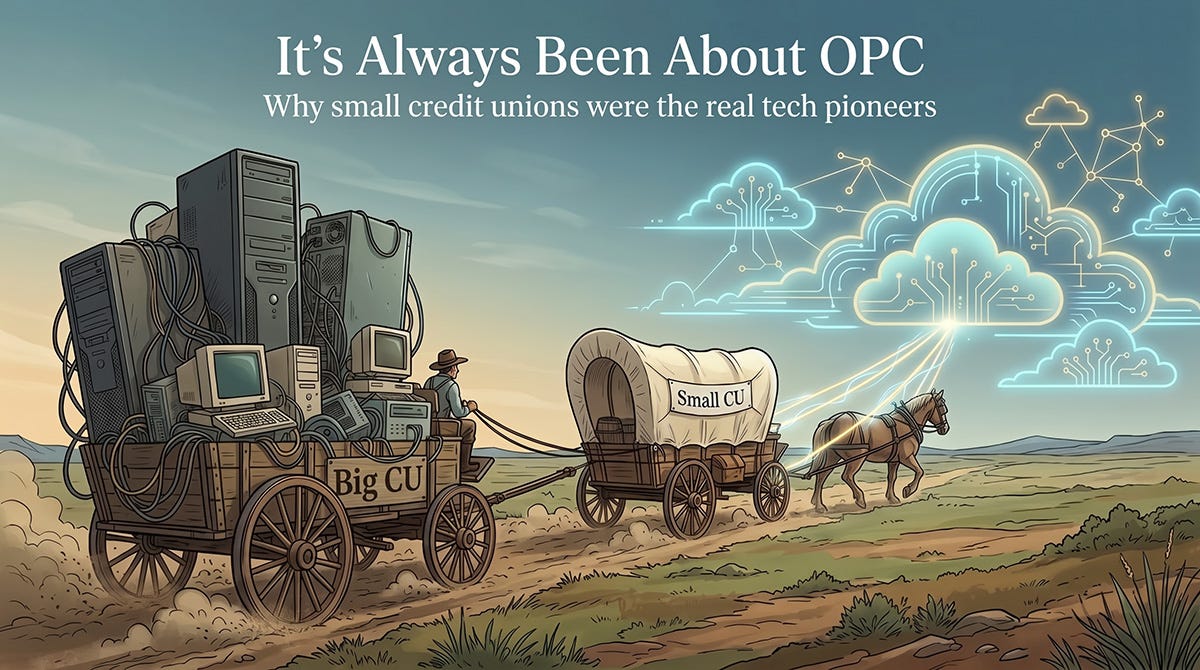
I didn’t realize at the time that I had become a pioneer in a paradigm shift that would eventually envelop the entire credit union core data processing industry. Neither did I realize that all the small credit unions running their cores in a service bureau environment – the ones that couldn’t run Symitar because it was an in-house solution – were also pioneers in this same movement. I’m talking about the seemingly inevitable and insatiable quest for OPC.
OPC: Just as Important as OPM
OPC, you say? What might that be?
I’m talking about other people’s computers, of course.
I’m willing to bet that you’ve never heard little service bureau credit unions framed as tech pioneers. Maybe that even sounds like something from the Upside Down. But think about it for a minute – or two.
Forty years ago, running your core in-house was the ultimate sign of technological savvy, sovereignty and superiority. Put another way, if you ran a big IT shop with a big IT staff, you were a badass.
And that was fine with your core processor. They didn’t have to invest a dime in data centers and got to completely dodge the operational liability bullet. If a disk blew up, who ya gonna call? Whoever held your hardware maintenance contract. Your processor’s software ran on OPC – except in this case, the “other people” were you and your credit union, and the “computers” were the ones you had to buy and maintain.
Meanwhile, the little service bureau credit unions were content to focus on the business of running a credit union and let OPC do what OPC is supposed to do.
The Big Shift
Thanks largely in part to improvements in bandwidth, things started to change. First came the single-tenant ASP (application service provider) model of OPC. That gave way to the multi-tenant SaaS (software as a service) model. And suddenly, smart credit unions were running more and more ancillary products off-prem.
I think it was about 2010 when Jack Henry decided to offer a hosted version of Episys, which was the Symitar product name at the time. They called the hosted version EASE, or Episys as a Service – a name that I thought up. It was a somewhat easy lift for Jack because they already had a couple of data centers in place running hosted versions of their banking platforms.
At first, it was just a trickle, but gradually, bigger and bigger Symitar credit unions began to migrate to EASE. It was a great double-dip for Jack. Get ‘em once with the hardware, services and software licenses that go with an in-house install, and then lock ‘em in later to a fat monthly service fee for the hosted solution.
Or looked at another way, the bigger credit unions finally figured out what the little service bureau credit unions had known for decades – namely that it’s always better when you can make it work with OPC.
Cores love hosting their own solutions because they love the predictable recurring revenue. As Jimmy Cole once said, it’s the lure of easy money; it’s got a very strong appeal. Except it’s not as easy as it looks. Being someone else’s OPC is expensive in many ways. If you run or have ever run an in-house shop, try multiplying that by 50 or a hundred credit unions.
Which brings us to our current cloud-centric world.
Stick to What You Do Best
Why in the world would any core processor try to out-OPC Google Cloud or Azure or AWS – or even think that they could? It seems like insanity to me.
So there’s my bold prediction. Are hosted core solutions going away? Not a chance. The little service bureau credit unions have known this all along. The question is: Who’s going to host them? Clue: It ain’t gonna be the core providers and their legacy data centers.
At that point, we will have achieved the perfect trinity. OPC providers like Google and Microsoft and Amazon can focus on doing what they do best. Software developers like Corelation and Jack Henry and Fiserv and Mambu can focus on what they do best. And even the biggest credit unions can make like little service bureau credit unions and focus on what they do best.