


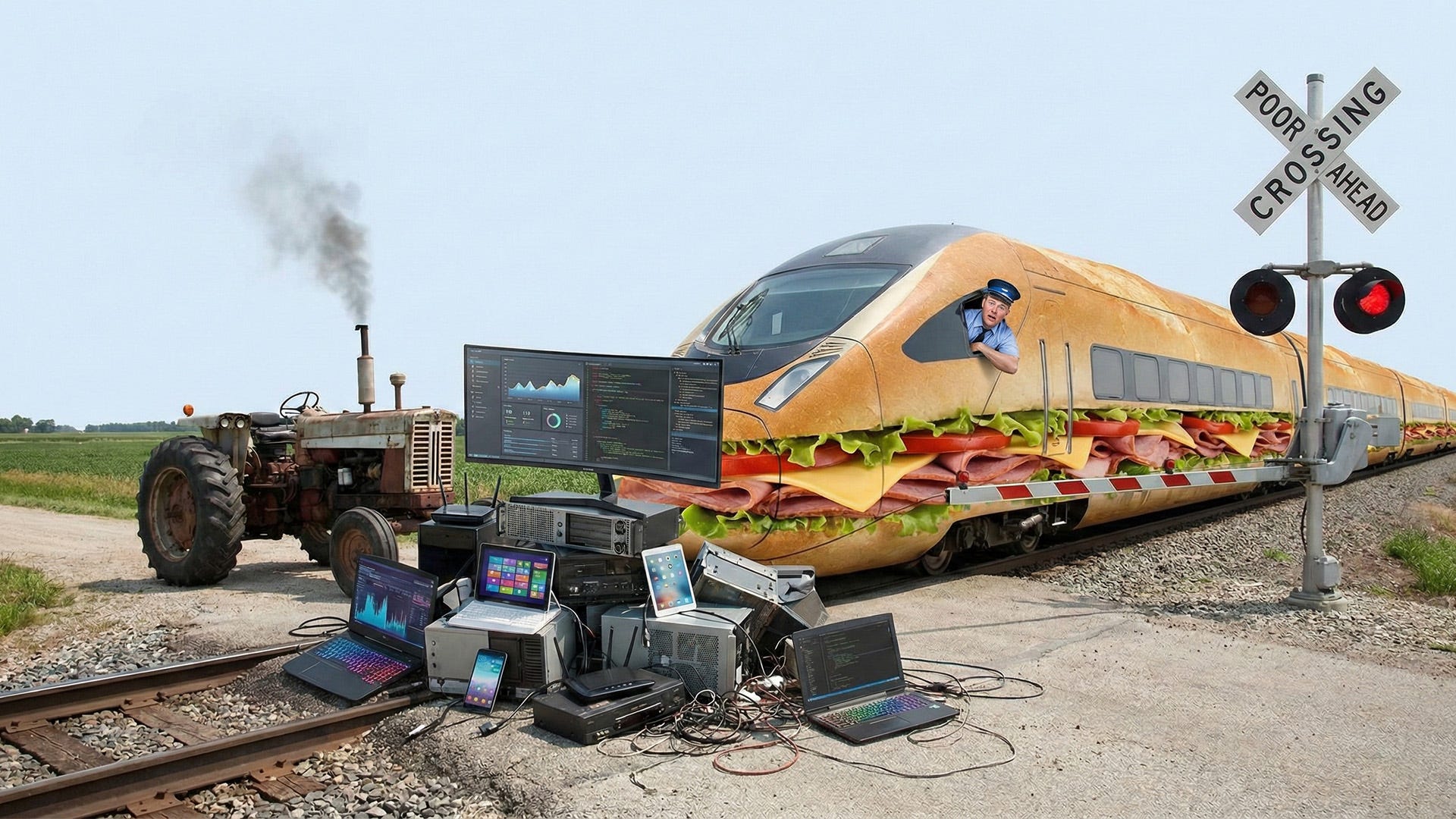
It’s been at least a decade since the tech world became obsessed with creating a “frictionless” user experience. To be sure, frictionless beats the heck out of the alternative. However, more often than not, we define friction as entirely a process problem. We assume that if we streamline the process, the friction goes away.
Not necessarily. While we put all our effort into addressing functional friction, we often ignore cognitive friction – the mental tax of confusion and anxiety.
The Brenda-to-Cesar Hand-Off
I was reminded of this just the other night. My son and his family were over for our usual Monday night dinner. That’s eight people total. I usually cook, but we decided to have Jersey Mike’s delivered – which is normally a solid choice with this crew.
The process was indeed frictionless. I ordered eight sandwiches on the app, carefully identifying each one by the eater’s name so the Jersey Mike’s staff could mark them accordingly. Including the Ticketmaster-style fees, the bill came to about $100, which I paid with ApplePay. Seconds later, I got a text message from DoorDash providing a link to the order tracker.
Our dinner was on its way. Or so we thought.
A few minutes later, the tracker told me that “Brenda” was on her way to the store to pick up our food. At this point, the order was still more or less on schedule. Then, according to the tracker, Brenda arrived at the store and was waiting for my order. A couple of minutes later when I checked, Brenda had vanished. As far as the tracker was concerned, she no longer existed.
In her place, “Cesar” was on his way to the store to pick up my food, but he was about a mile and a half out. My assumption is that Brenda got to the store, the order wasn’t ready, and so she had to bail to make her next order, with the DoorDash system handing off responsibility to Cesar.
The Visibility Gap
I’m sure the technology worked exactly as designed. I had the option to text Cesar, which I did. Not surprisingly, he did not respond. So I called Jersey Mike’s to see what was going on.
Speaking with a very polite gentleman, I learned a couple of interesting things from this call. First, the store had no visibility into the delivery system. In fact, I knew more about my order’s fate than he did. He didn’t know I had ordered through the Jersey Mike’s app nor did he know DoorDash was picking up the order. He only knew that some delivery service was picking it up.
“Your order is ready to go, so it’s all up to DoorDash now,” the Jersey Mike’s employee told me.
That led to an obvious question. My son and I had both ordered Hot Italians (because why wouldn’t we), so I asked whether my hot sandwiches would actually arrive hot. The employee made a specific promise: “If DoorDash doesn’t show up in the next couple of minutes, I will personally remake those hot sandwiches.”
When Efficiency Breeds Failure
Well, Cesar didn’t show up within a couple of minutes and I’m pretty sure that employee did not remake our hot sandwiches. They were cold and gross upon arrival. And as if to add insult to injury, the sandwich maker apparently decided it was too much trouble to write each person’s name on their sandwich.
This may not have seemed like a big deal to the sandwich maker, but to eight hungry people who were eating 45 minutes later than expected, it was a very big deal. Yes, even the humans in the loop failed me.
I’m sure the APIs were firing on all cylinders, and the process did precisely what the engineers intended. Yet, I ended up confused (What the hell happened to Brenda?) and frustrated (Why was my cold hot sandwich 45 minutes later?). Was this a Jersey Mike’s issue or a DoorDash issue? I’ll never know for sure. But I do know that I’m a Jersey Mike’s customer, not a DoorDash customer, which means I will use my wallet to hold Jersey Mike’s responsible.
The Accountability Lesson for Credit Unions
Therein lies the biggest lesson for credit unions and the fintechs that serve them. If something goes south, the member doesn’t care if there’s some behind-the-scenes tech provider at fault. You chose that tech provider, so you need to shoulder the responsibility.
Functional friction is still an issue that you must address, but it’s only one side of that friction coin. If you can eliminate member confusion and member frustration, you’ve won. Period. No member will switch to a megabank because they have a streamlined billpay system that makes no sense or a cutting-edge voicebot that refuses to let you speak with a live agent.
It’s not about how many steps you can eliminate. In the end, it’s about how you make your members feel—just like it has been since Moses was a boy. When you outsource the process, you aren’t outsourcing the accountability. If the “hot” experience you promised arrives cold, the slickest API in the world won’t save your brand.
Stay frictionless, my friends.