


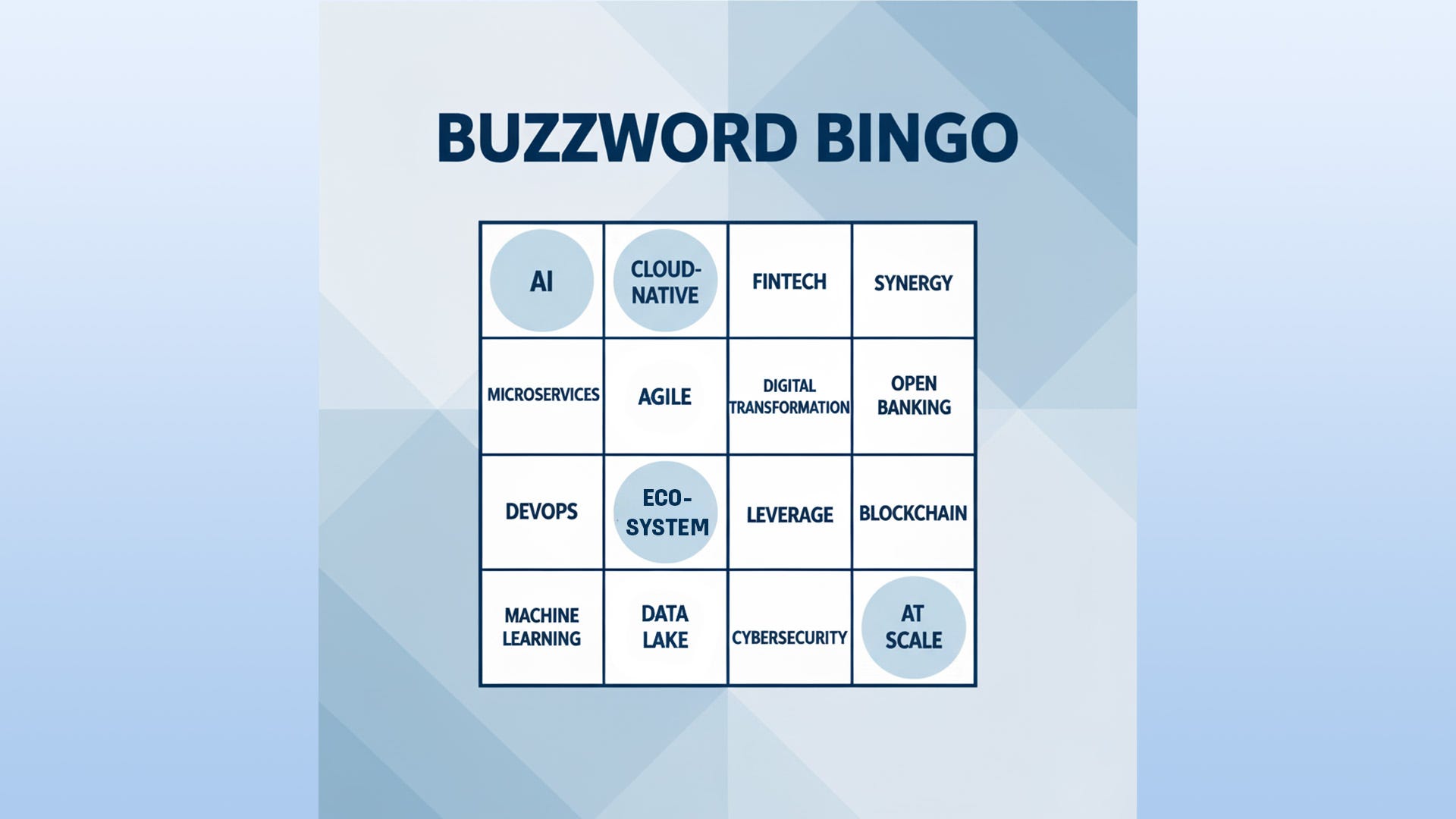
If you clicked on this link hoping to find a tutorial on how to build a really big AI-based, cloud-native ecosystem, I have some bad news for you. This ain’t it. Even if such a thing were possible, I’d be the wrong guy for the job. I am definitely no coder (although what I lack in coding skill I more than make up for in sarcasm).
Nope. After two weeks in an immersive course on “Buzzwords as a Second Language” – namely Money20/20 and VentureTech – I’m just a word nerd here to help bring you up to speed on the ever-changing lexicon of financial technology.
Let’s break it all down.
Artificial Intelligence (AI)
Let’s start with a little pop quiz. AI is a technology that:
Can be used to perform mundane tasks that people don’t want to perform and can be used to perform tasks that are impossible for people to perform.
Can be used as the basis for a stand-alone product and can be baked into an existing product to make it better.
Can achieve amazing results and can be slandered by having its name slapped on fake AI.
All of the above.
If you chose 4, congrats. You just daubed your first space on the bingo card. For anyone who missed this, let me provide the buzzwordnetics for AI.
What it’s supposed to mean: A specific set of advanced technologies (like machine learning, large language models, and neural networks) that are trained on massive datasets. The goal is to use these technologies to perform complex tasks that normally require human intelligence, such as recognizing patterns, making predictions, understanding natural language, or generating new content.
What you may have heard: A magic, all-knowing “brain” that can be “added” to any product to make it futuristic and smart. It’s often used as a catch-all term for anything that involves data, automation, or even a simple “if/then” rule. For many, it’s just a marketing label that means “new and improved.”
Why the distinction matters: This is the most critical distinction of all. Using the label “AI” for a simple analytics dashboard (what’s known as “AI-washing”) creates massive hype and leads to disappointment. Real AI is a powerful tool, but it requires enormous amounts of high-quality data, a clear problem to solve, and significant computing power. The distinction separates a genuine strategic investment from a superficial marketing claim. I can’t emphasize the high-quality data part enough. Don’t expect AI to clean up your crappy data. Remember, crap in, crap out.
Cloud Native
Let’s turn to Wikipedia for a quick definition of cloud native: “Cloud native computing is an approach in software development that utilizes cloud computing to build and run scalable applications in modern, dynamic environments such as public, private, and hybrid clouds. These technologies, such as containers, microservices, serverless functions, cloud native processors and immutable infrastructure, deployed via declarative code are common elements of this architectural style. Cloud native technologies focus on minimizing users’ operational burden.”
That’s an accurate and important definition, but it’s not generally how I hear the term used. When most people tell me their product is cloud native, what they’re really telling me is that the product was built for cloud delivery from the git-go, i.e., there was never an on-prem version.
I suppose that’s important to a point, but which would you rather have – a really crummy cloud-native app or an outstanding on-prem app that got ported to the cloud? Bottom line: Don’t put too much stock in the cloud-native claim.
Ecosystems
Let me be 100% clear. I am in no way claiming ownership of this term. However, I can tell you that I started using this term ecosystem 15 years ago to describe all the parties touched by Jack Henry’s Symitar platform (where I was marketing manager) and how they were all interconnected, both technologically and from a business standpoint.
Today, every vendor claims to be building an ecosystem. The term seems to have become shorthand for “the list of vendors that have integrated to our platform in at least one common customer’s institution.” Is that an ecosystem? No, I don’t think so. To me, the key to a true ecosystem is interconnectivity. The question is: Do all these vendors merely integrate to my platform, or am I able to orchestrate at some level their connectivity with each other? The latter answer is what constitutes an ecosystem, imho.
At Scale
Think about all the tech products you’ve heard described lately. Now think about how many of those descriptions were capped off with “at scale.” Or if it’s easier to calculate, how many were not capped off with “at scale”?
When a vendor tells you its platform can do its job at scale, the vendor is telling you one of two things. One possibility is that the vendor wants to assure you that if your credit union triples in size overnight, they have you covered. The other possibility is that, although you’re just a $750 million credit union, their platform was designed to go after much bigger fish, like Navy, for example. You wanna know whether a software product works “at scale” for a billion-dollar credit union? Ask a billion-dollar credit union that’s already using it.
Cooperation and information sharing among credit union technologists is the industry’s superpower. In fact, it’s almost like – dare I say – we have our own ecosystem.
What buzzwords drive you crazy? Let me know.